
What Makes a Luxury Facial Different?
Quick Answer
Luxury is a label, not a treatment type, so a luxury facial isn't one specific thing. What can differ is the appointment length, the number of steps, the products, the extras, and the setting, and none of that guarantees a better result for your skin. Ask what is included, and judge the facial by that rather than by the name.
Introduction
Somewhere on most facial menus there is a word that sounds like an upgrade: luxury, premium, signature, advanced. It makes a higher price feel easier to explain.
The trouble is that these words don't tell you what you will actually get. Two facials with the same label can differ in length, steps, products, and who performs them.
This guide looks at what luxury can really mean on a facial menu, which words carry weight and which don't, and whether paying more buys a better result.
It also gives you questions to ask before you pay, so the decision rests on what is included instead of what the facial is called.
Is a Luxury Facial an Actual Treatment Type?
No. "Luxury facial" isn't a standardized treatment category with a required set of steps or products. One studio may use the word for a longer appointment with extra massage, another for a facial built around a particular product line, and another for a high-priced specialty treatment.
The rules for cosmetic claims don't fill that gap. The law doesn't require cosmetic labeling to be approved by a federal agency before products go on the market, and there is no federal list of approved or accepted claims for cosmetics. Claims have to be truthful and not misleading, and advertising claims are overseen separately by the Federal Trade Commission. None of that tells you whether a particular facial will deliver better results.
What Can Actually Be Different in a Premium Facial?
These are the things that can change as a facial gets more expensive, and what to look at in each one.
Appointment length. A longer appointment may give the provider more time for extra steps, a consultation, or a slower pace, depending on the service, but length alone doesn't make a facial better. At Blink & Wink, facial services run from 30 minutes for Express Dermaplaning to 45 minutes for the classic facial with extractions if needed, and 50 minutes for Classic Dermaplaning. The useful comparison is how much of that time is the facial itself, and how much is the consultation and settling in.
Number of steps. More steps can mean a more involved treatment, but they can also mean more layers of product. Blink & Wink describes its facial service as a multi-step treatment that can include double cleansing, exfoliation, deep hydration, targeted serums and masks, and facial massage. The name tells you very little. The list of steps, and the reason each one suits your skin, tells you more.
Products. Studios use different product lines. Blink & Wink says it uses Skin Script products. A product line is a fact about what a studio buys, not a measure of how well it will work on you, so get the product names, especially if your skin is sensitive.
Add-ons. Extras such as dermaplaning or a special mask add time and cost. Find out what each one is meant to do, whether it suits your skin, and what it adds to the total.
Setting and service. A quiet room, a robe, music, and time to relax can make the appointment more enjoyable. They affect how the visit feels, not how the facial treats your skin.
Who performs it. The facial's name won't tell you who performs it or what training they have, so ask.
None of these is a guarantee. More time, more steps, or a pricier product doesn't promise a better result for your skin.
How to Read the Words on a Facial Menu
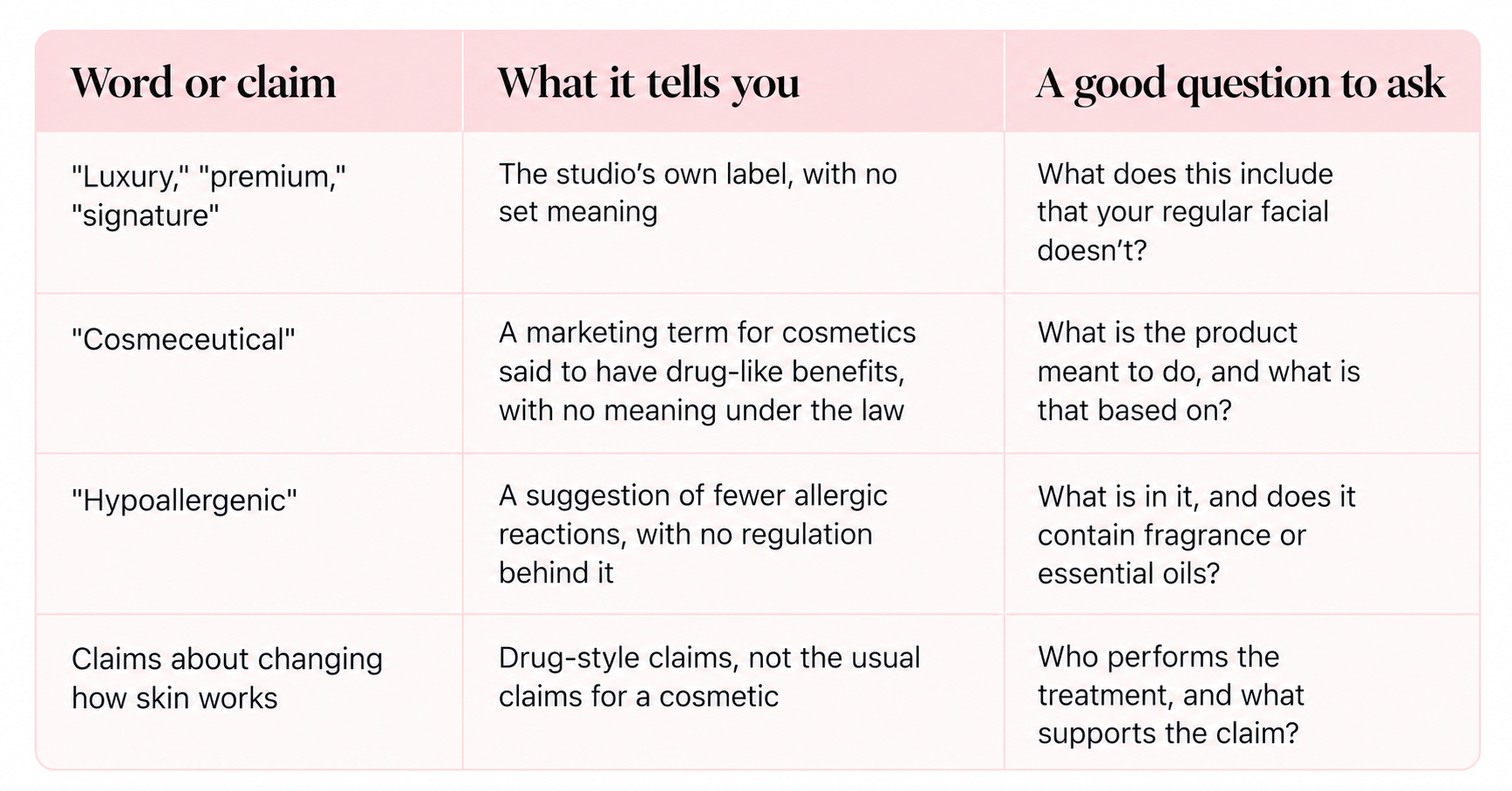
Two of these terms have been looked at directly. The term cosmeceutical has no meaning under the law, even though the cosmetic industry uses it for cosmetics said to have medicinal or drug-like benefits. For hypoallergenic, there is no regulation defining or governing the term, manufacturers aren't required to submit evidence for the claim, and federal guidance says it knows of no scientific studies showing that hypoallergenic cosmetics cause fewer adverse reactions than competing conventional products.
That doesn't make the products bad. It means the word alone can't tell you whether a product suits your skin.
Does a Higher Price Mean Better Results?
A higher price, by itself, doesn't establish that a facial will give better results for your skin. Dermatologist guidance on facial masks points somewhere else: whether the ingredients fit your skin concern. It says using masks with the wrong ingredients for you can lead to irritation, dryness, or even breakouts, and that the right mask depends on your specific skin needs.
That guidance is written for masks you buy yourself, not for professional facials. The same consumer principle is still useful when you compare facials: a more expensive product isn't automatically a better match for your skin, or gentler on it. If your skin is sensitive, ask about fragrance and essential oils, which dermatologists say can irritate skin or cause an allergic rash.
A higher price can buy things that have nothing to do with results: more time, more comfort, a nicer room. Those can be worth paying for if you want them. Just be clear about what you are buying.
When a Treatment Is More Than a Facial
Facial menus sometimes include treatments that promise more than cleansing and a fresh look. Federal guidance on cosmetic claims says that if a product is marketed with claims about treating or preventing disease, or affecting the structure or function of the body, including the skin, it is a drug under the law, even if it changes how the skin looks. A claim like that deserves a closer look when you see it on a menu.
That guidance covers how products are marketed, not how every salon service is run, so training and licensing are separate questions for you to ask. If a service involves needles or injections, find out exactly what procedure is being offered, who performs it, what training or licensing applies, and whether a medical professional is involved. Ask what supports any big promise, too.
What to Ask Before You Pay More for a Facial
What exactly makes this facial different from your regular one?
What is included in the price, and what counts as an add-on?
What does the total come to, including add-ons and any service fees?
Can I see the product names, and an ingredient list if my skin is sensitive?
How much of the appointment is the facial itself?
Who will perform it, and what is their experience with my skin concern?
What results can I realistically expect, and how long do they last?
What happens if my skin reacts during the treatment?
Is there a shorter or simpler version I could try first?
A studio that answers these plainly is giving you more useful information than any label.
Facials at Blink & Wink in Buckhead
Blink & Wink's facial menu lists each facial by what it includes and how long it takes, rather than by a label such as luxury or premium. It currently lists classic and dermaplaning facial options, along with a specialty dermaplaning service. Because service names and pricing can change, confirm the current menu when you book. The studio recommends a facial every 4 to 6 weeks, depending on your skin type and goals, which is its own recommendation rather than a universal rule.
If you are comparing facials in Atlanta, bring the questions above and call (404) 906-3200. The studio is at 5299 Roswell Road NE in Buckhead.
Conclusion
Luxury on a facial menu is a label, not a standard. What can really differ is the length of the appointment, the steps, the products, the extras, the setting, and who performs it, and none of those promises a better result for your skin.
If you are weighing a luxury facial in Atlanta against a regular one, find out what is included, what the total is, and what the studio expects the facial to do. Choose on those answers, not on the name.
FAQ
Is a luxury facial worth it?
It depends on what you value. If you want a longer appointment, a relaxing setting, or an add-on you have asked about, paying more can make sense. A higher price, by itself, doesn't establish better results for your skin, so base the decision on what is included.
Is a luxury facial better for your skin?
Not automatically. Dermatologist guidance on facial masks says the right choice depends on your specific skin needs, and that ingredients that don't suit you can cause irritation, dryness, or breakouts.
What does "cosmeceutical" mean on a facial menu?
It is a marketing term for cosmetics said to have medicinal or drug-like benefits. Federal guidance says the term has no meaning under the law, so ask what the product is meant to do and what supports that.
Does "hypoallergenic" mean safe for sensitive skin?
Not necessarily. Federal guidance says no regulation defines or governs the term, manufacturers aren't required to submit evidence for it, and it knows of no scientific studies showing such products cause fewer adverse reactions. If your skin is sensitive, ask what is in the product, including any fragrance or essential oils.
How long should a luxury facial take?
There is no standard length. At Blink & Wink, facials run from 30 to 50 minutes. The number that matters most is how much of the appointment is the facial itself.
What should a luxury facial include?
There is no set list, because luxury isn't a defined treatment. Ask the studio which steps, products, and add-ons are included and what the total is.
